Join our Official WhatsApp Channel
Get daily alerts on fully funded scholarships, remote jobs, and visa sponsorships before anyone else.
Quick Intelligence
- As you prepare for your global academic journey in 2026, one of the most critical decisions you will face is choosing the right entrance exam.
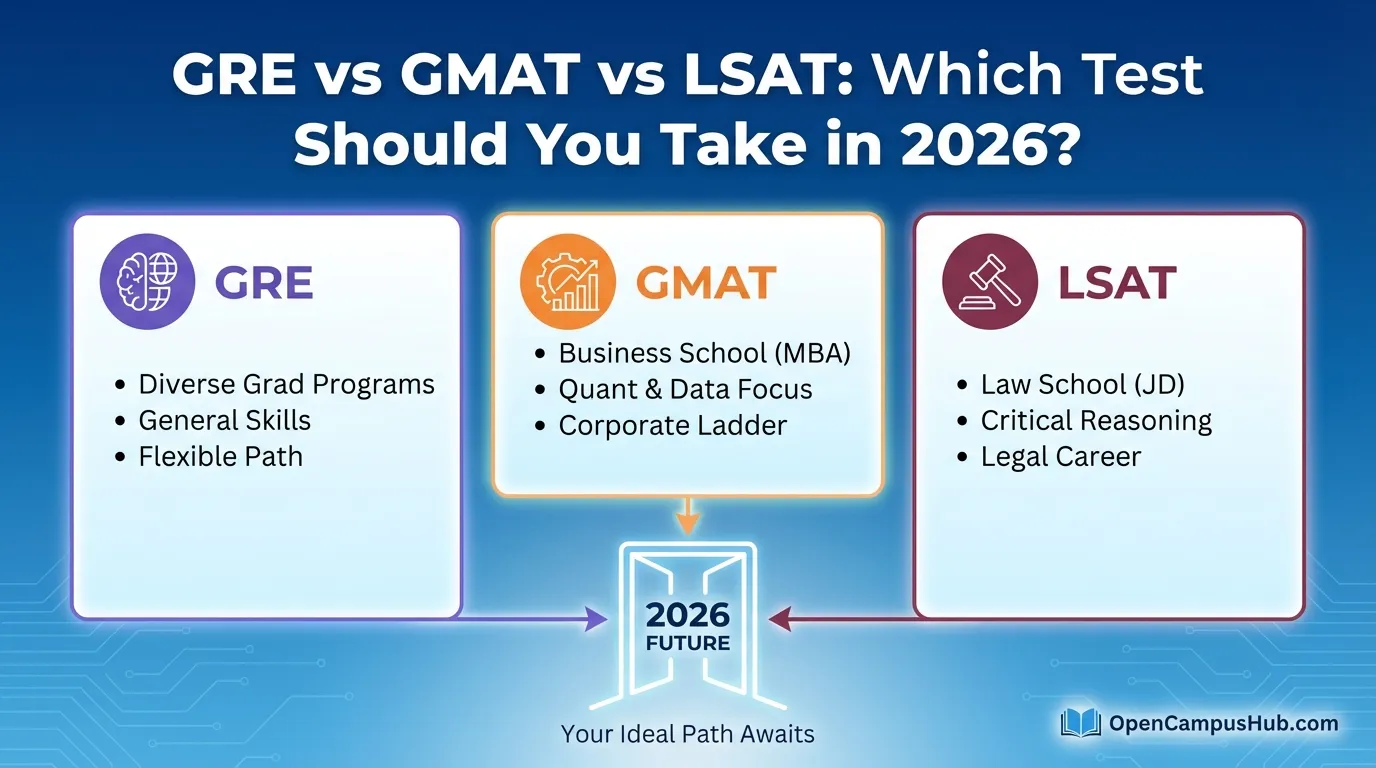
- GRE: The Flexible GiantThe Graduate Record Examination (GRE) is the most versatile test.
- It is accepted by thousands of graduate programs worldwide, including many business and law schools.Who should take it?
As you prepare for your global academic journey in 2026, one of the most critical decisions you will face is choosing the right entrance exam. Whether you are aiming for a Master's in Engineering, an MBA at an Ivy League school, or a Juris Doctor (JD) at a top law school, the test you choose will define your application strategy.
This guide provides a side-by-side comparison of the GRE, GMAT, and LSAT to help you identify which exam aligns with your strengths and career goals.
1. At a Glance: The Core Differences
| Feature | GRE (General) | GMAT Focus Edition | LSAT |
|---|---|---|---|
| Primary Goal | Graduate School (General) | Business School (MBA) | Law School (JD) |
| Duration | ~1 Hour 58 Minutes | 2 Hours 15 Minutes | ~3 Hours |
| Scoring Range | 130–170 per section | 205–805 | 120–180 |
| Sections | Quant, Verbal, Writing | Quant, Verbal, Data Insights | Logical & Analytical Reasoning |
| Validity | 5 Years | 5 Years | 5 Years |
2. GRE: The Flexible Giant
The Graduate Record Examination (GRE) is the most versatile test. It is accepted by thousands of graduate programs worldwide, including many business and law schools.
Who should take it? Students applying for Master’s (MS/MA) or PhD programs. It is also a great alternative for MBA applicants who find the GMAT Quant section too difficult.
The "Vocabulary" Challenge: The GRE is famous for testing high-level, sophisticated vocabulary. If you are an avid reader with a strong grasp of complex English, this test will favor you.
Quant Level: Focuses more on geometry and number properties. It is generally considered "friendlier" for non-math majors than the GMAT.
3. GMAT Focus Edition: The Business Specialist
In late 2023, the GMAT transitioned to the Focus Edition, a shorter, more streamlined version of the classic test specifically designed for the modern business world.
Who should take it? Aspiring MBA and Master’s in Finance/Management students. While many schools now accept the GRE, the GMAT remains the "Gold Standard" for top-tier business programs.
Data Insights Section: The new GMAT focuses heavily on your ability to interpret graphs, spreadsheets, and complex data sets—skills essential for business leaders.
No Essay: The GMAT Focus Edition has removed the Analytical Writing Assessment (AWA), making it a purely quantitative and logic-driven exam.
4. LSAT: The Logic Fortress
The Law School Admission Test (LSAT) is a unique exam that doesn't test math or vocabulary. Instead, it tests your ability to think like a lawyer.
Who should take it? Students aiming for Law Schools in the USA, Canada, and Australia.
Logical Reasoning: You will be required to break down arguments, find flaws in logic, and predict conclusions.
No Math Required: This is the only major entrance exam that has zero quantitative requirements. However, it is widely considered the most mentally exhausting test due to the extreme time pressure and rigorous logic puzzles.
5. 2026 Strategy: How to Choose?
To make the right choice, follow these three steps:
Check your Target List: Look at the "Admissions" page of your top 5 universities. If all 5 accept the GRE, but only 2 accept the GMAT, the GRE is the safer bet.
Take a Diagnostic Test: Take a full-length practice test for both GRE and GMAT without any prep. Your baseline score will immediately show which format feels more natural to your thinking style.
Math vs. Words: If you struggle with high-level logic and data interpretation but excel at geometry and vocabulary, choose the GRE. If you are a "Data Native" who loves solving business-style problems, choose the GMAT.
6. Preparation Roadmap for 2026
The 3-Month Rule: Regardless of the test, aim for 10–15 hours of study per week for at least three months.
Official Materials: Always start with the official guides (ETS for GRE, GMAC for GMAT, LSAC for LSAT). Their practice questions are the only ones that accurately mimic the real exam.
Error Logs: Don't just solve questions. Keep a log of why you got a question wrong. Was it a concept gap, a silly mistake, or a time management issue?
Conclusion
There is no "easiest" test; there is only the test that best reflects your unique cognitive strengths. By selecting the exam that matches your skills, you can significantly boost your chances of admission to world-class institutions in 2026.
Struggling to improve your score? Join our WhatsApp community for weekly "Test Prep Drills" and free access to our 2026 GRE/GMAT Formula Sheets!
Frequently Asked Questions
Should I take the GRE or GMAT for business school in 2026?
In 2026, most top-tier business schools accept both the GRE and the GMAT equally. The GMAT is specifically designed for business school applicants and focuses heavily on data sufficiency and integrated reasoning, making it the traditional choice. However, the GRE is increasingly popular for its broader format and is a great option if you have strong verbal skills or are considering dual-degree programs outside of business.
Can I use the GRE to apply to law school instead of the LSAT?
Yes, a growing number of ABA-accredited law schools now accept the GRE in lieu of the LSAT. While the LSAT remains the gold standard for legal education due to its specific focus on logical reasoning and reading comprehension, the GRE is a viable alternative if you are applying to multiple programs that accept it. Always check the specific admissions requirements for each law school on your list before deciding which test to take.
Which graduate entrance exam is the easiest to study for?
"Easiest" is subjective and depends on your academic strengths. The GRE is often considered the most versatile but requires a strong vocabulary. The GMAT is typically more challenging for students who struggle with advanced quantitative concepts, while the LSAT is widely considered the most difficult to prepare for because it tests specific analytical skills that are not emphasized in traditional undergraduate coursework. We recommend taking a free practice test for each to determine which exam aligns best with your natural abilities.
Share this article
Discussion
Welcome to the discussion. Please keep questions relevant to the 2026 cycle. Our team aims to respond to critical inquiries within 48 hours.