Get Scholarship Alerts on WhatsApp
Don't miss the next deadline! Join our channel for fully funded scholarships & study abroad tips.
Free community. No paid links or spam.
Quick Intelligence
- 1
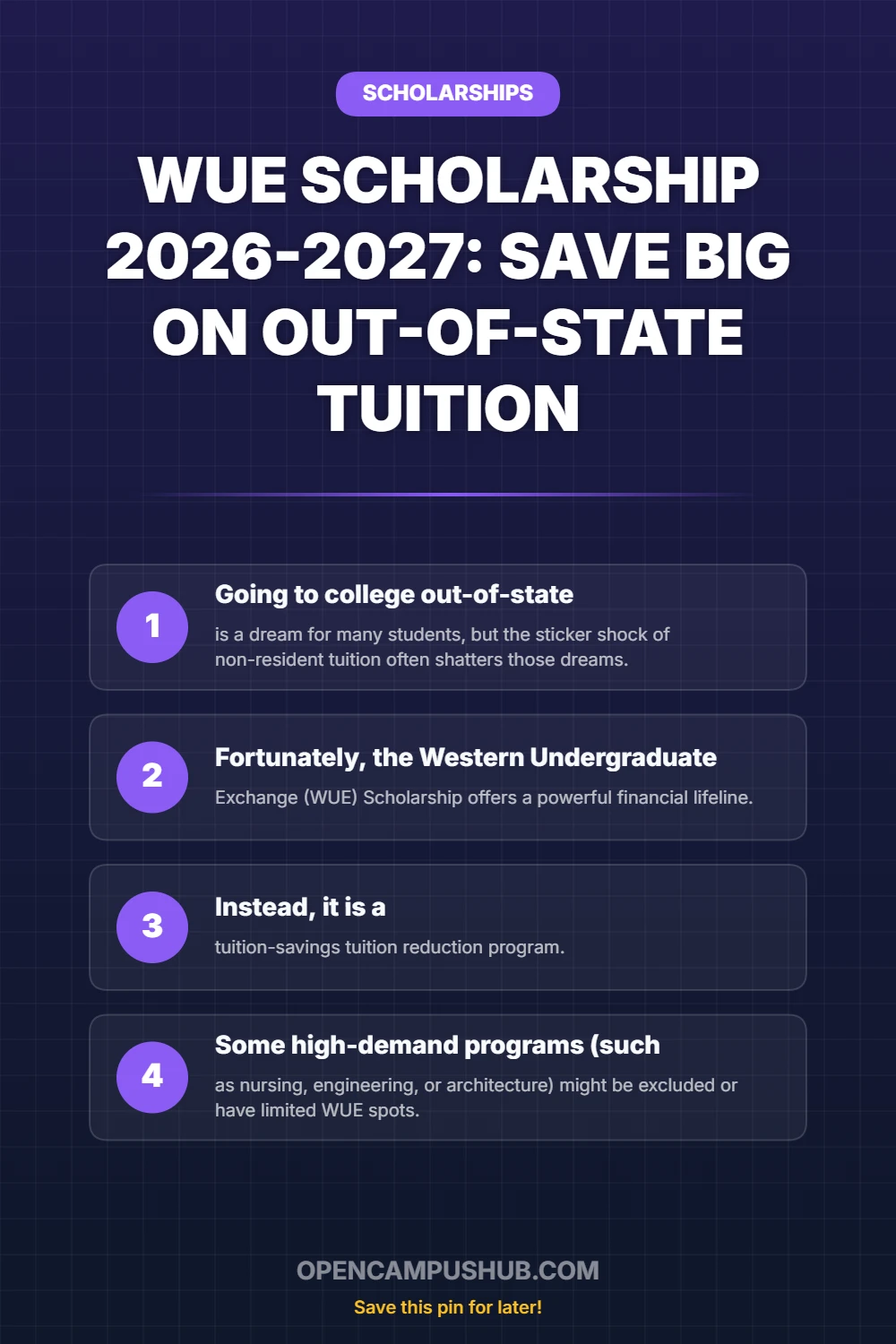
Going to college out-of-state is a dream for many students, but the sticker shock of non-resident tuition often shatters those dreams.
- 2
Fortunately, the Western Undergraduate Exchange (WUE) Scholarship offers a powerful financial lifeline.
- 3
Instead, it is a tuition-savings tuition reduction program.
- 4
Some high-demand programs (such as nursing, engineering, or architecture) might be excluded or have limited WUE spots.
Going to college out-of-state is a dream for many students, but the sticker shock of non-resident tuition often shatters those dreams. Fortunately, the Western Undergraduate Exchange (WUE) Scholarship offers a powerful financial lifeline. Managed by the Western Interstate Commission for Higher Education (WICHE), the WUE program allows students from participating western states and territories to enroll in designated undergraduate programs at participating public colleges and universities outside their home state at a significantly reduced tuition rate.
Table of Contents
- 1. What is the WUE Scholarship and How Does It Work?
- 2. Participating States and Territories (2026-2027)
- 3. WUE Scholarship Eligibility Requirements for 2026-2027
- 4. Step-by-Step Guide: How to Apply for the WUE Scholarship
- 5. Maximizing Your Savings: WUE vs. Other Financial Aid
- 6. Frequently Asked Questions (FAQs)
- 7. Conclusion
If you are planning to attend college during the 2026-2027 academic year, understanding the WUE scholarship inside and out is one of the smartest financial moves you can make. In this comprehensive guide, we will break down participating states, eligibility requirements, potential savings, and the exact step-by-step process to secure this coveted tuition discount.
What is the WUE Scholarship and How Does It Work?
The Western Undergraduate Exchange is not a traditional scholarship where you write an essay to win a lump sum of cash. Instead, it is a tuition-savings tuition reduction program. Normally, out-of-state students pay full non-resident tuition, which can often be triple or quadruple what in-state residents pay.
Under the WUE program, eligible students pay no more than 150% of the institution's regular in-state resident tuition. To put that into perspective, if an in-state student pays $10,000 per year in tuition, a WUE student would pay $15,000 instead of the standard out-of-state rate of $30,000 or more. This arrangement saves participating students an average of $9,000 to $15,000 per year.
Participating States and Territories (2026-2027)
The WUE program spans a vast geographic area in the western United States. To qualify as a student applicant, your permanent legal residence must be in one of the following WICHE member states or territories:
- Alaska
- Arizona
- California
- Colorado
- Hawaii
- Idaho
- Montana
- Nevada
- New Mexico
- North Dakota
- Oregon
- South Dakota
- Utah
- Washington
- Wyoming
- Commonwealth of the Northern Mariana Islands (CNMI)
- Guam
Institutions in these same states (plus a few specific reciprocal exceptions) host WUE programs. Over 160 public colleges and universities participate, offering hundreds of different majors and degree tracks.
WUE Scholarship Eligibility Requirements for 2026-2027
While the exact criteria vary slightly by university, the baseline requirements to qualify for the WUE discount during the 2026-2027 academic year include:
- Residency: You must be a current resident of one of the WICHE-approved states or territories listed above. Proof of residency (such as a driver's license, high school transcripts, or parent tax returns) will be required.
- Academic Achievement: Because WUE slots are often limited and highly competitive, many universities have minimum GPA requirements. While some schools accept a 2.5 GPA, more competitive institutions may require a 3.0 or higher.
- Program Availability: Not all majors at a participating university are eligible for WUE. Some high-demand programs (such as nursing, engineering, or architecture) might be excluded or have limited WUE spots. Always check the specific institution's WUE major list.
- Enrollment Status: You generally must be enrolled as a full-time undergraduate student seeking your first bachelor's degree. Graduate programs and second bachelor's degrees are typically excluded.
Step-by-Step Guide: How to Apply for the WUE Scholarship
Securing a WUE tuition reduction requires proactive planning. Because slots can be limited at top-tier institutions, following the correct timeline is crucial.
Step 1: Research Participating Schools and Majors
Use the official WICHE WUE Savings Finder website to explore which colleges offer your desired major under the WUE program. Make a list of target schools and note their specific WUE eligibility criteria and application deadlines.
Step 2: Apply for Admission
You must apply for standard undergraduate admission to the university of your choice. On the university's application form, there will usually be a specific question asking if you wish to be considered for the WUE rate. Check "Yes" and ensure your residency information matches a WICHE state.
Step 3: Submit Required Documentation
Some universities automatically consider all incoming out-of-state applicants for WUE based on their GPA and test scores. Others require a separate WUE application form. Make sure you submit all transcripts, test scores (if applicable), and any supplemental WUE forms well before the priority deadline.
Step 4: Accept the WUE Award
If accepted, your financial aid award letter or admissions packet will explicitly state that you have been granted the WUE tuition rate. Review the terms, as some schools require you to maintain a certain college GPA (e.g., 2.75 or 3.0) to keep the discount for subsequent years.
Maximizing Your Savings: WUE vs. Other Financial Aid
One common question students ask is whether they can combine the WUE scholarship with other forms of financial aid, such as institutional merit scholarships or federal grants.
The answer depends entirely on the school policy:
- Stackable Aid: Some universities allow you to stack institutional merit scholarships on top of your WUE tuition rate, driving your out-of-pocket costs down even further.
- Non-Stackable Aid: Other institutions consider the WUE discount itself to be your primary merit award and will not allow additional university-funded scholarships on top of it. Always consult the financial aid office of your prospective school.
Regardless of stacking policies, federal financial aid—including Pell Grants, federal student loans, and work-study programs—can always be used in conjunction with the WUE scholarship.
Don't miss the next scholarship!
Join our WhatsApp Channel for instant scholarship alerts.
Frequently Asked Questions (FAQs)
Can I gain residency in my WUE state later and get in-state tuition?
Generally, no. Most states have very strict residency laws for tuition purposes. Participating in the WUE program often flags you as a non-resident for the duration of your undergraduate studies. If your ultimate goal is to establish permanent residency, check the specific state's laws regarding independent student status.
Does WUE apply to graduate school?
No. The Western Undergraduate Exchange is strictly designed for undergraduate students pursuing their first bachelor's degree. However, WICHE does offer a separate program called the Western Regional Graduate Program (WRGP) for master's and doctoral students.
What happens if I change my major?
If you switch your major after enrolling, you must ensure your new major is also approved for the WUE discount at that institution. Switching to a non-WUE eligible major will usually result in your tuition reverting to the standard out-of-state rate.
Conclusion
The WUE Scholarship for 2026-2027 is an incredible opportunity for students living in the American West to pursue higher education across state lines without falling into crippling debt. By reducing tuition to 150% of the resident rate, colleges make out-of-state education genuinely affordable. Start your research early, check major availability, and submit your college applications ahead of deadlines to secure your path to substantial tuition savings!
Written by the OpenCampusHub Editorial Team
Our global team of education and mobility experts is dedicated to verifying international opportunities. We ensure every guide meets strict standards for accuracy, leveraging official sources and real-world data.
Share this article
Discussion
Welcome to the discussion. Please keep questions relevant to the 2026 cycle. Our team aims to respond to critical inquiries within 48 hours.