Join our Official WhatsApp Channel
Get daily alerts on fully funded scholarships, remote jobs, and visa sponsorships before anyone else.
Free community. No paid links or spam.
Quick Intelligence
- 1
A Medium of Instruction (MOI) certificate is an official academic document provided by your university.
- 2
It explicitly states that the language used for teaching and assessing your previous degree was English.
- 3
It is frequently used as a substitute for IELTS or TOEFL during university admissions.
- 4
How to Get an MOI Certificate from University Contact your university's Registrar Office or Student Affairs department.
What is an MOI Certificate?
A Medium of Instruction (MOI) certificate is an official academic document provided by your university. It explicitly states that the language used for teaching and assessing your previous degree was English. It is frequently used as a substitute for IELTS or TOEFL during university admissions.
Table of Contents
- 1. What is an MOI Certificate?
- 2. How to Get an MOI Certificate from University
- 3. Understanding the Medium of Instruction (MOI) Certificate
- 4. Why Do You Need an MOI Certificate?
- 5. How to Get an MOI Certificate from Your University
- 6. Sample Medium of Instruction Certificate Format
- 7. Countries and Universities Accepting MOI in 2027
- 8. Table: MOI Acceptance Overview
- 9. Frequently Asked Questions (FAQ)
- 10. Conclusion
How to Get an MOI Certificate from University
- Contact your university's Registrar Office or Student Affairs department.
- Request the official Medium of Instruction issuance form.
- Pay the required processing fee (if applicable).
- Provide your student ID, academic transcript, and a copy of your degree.
- Receive the stamped and signed MOI on official university letterhead.
Understanding the Medium of Instruction (MOI) Certificate
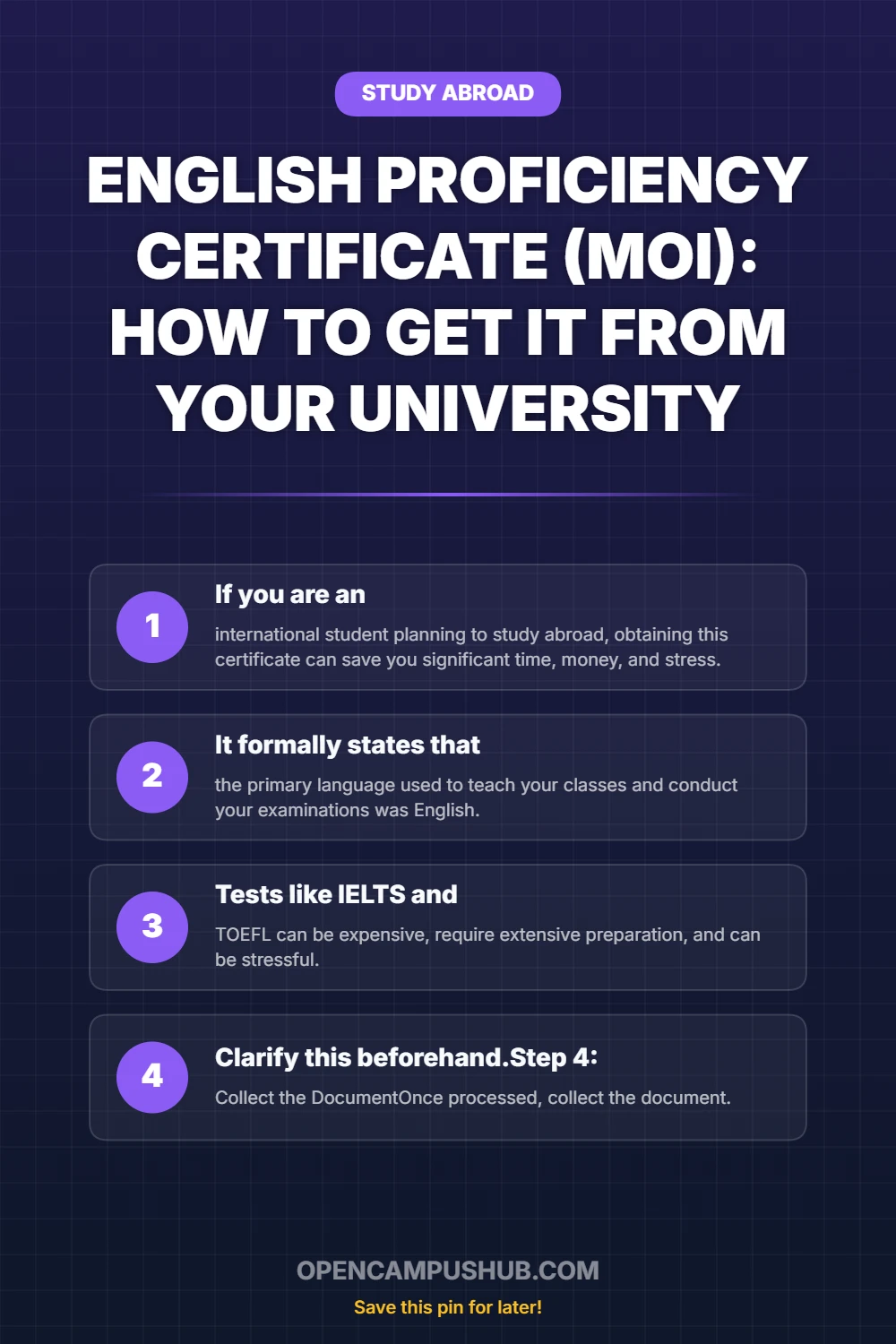
The Medium of Instruction (MOI) certificate is a formal document that can serve as a substitute for standard English proficiency tests like IELTS or TOEFL. If you are an international student planning to study abroad, obtaining this certificate can save you significant time, money, and stress. This comprehensive guide will explain everything you need to know about the MOI certificate, how to acquire it, and where it is accepted.
What is a Medium of Instruction Certificate?
Simply put, an MOI certificate is an official letter from your previous educational institution (high school, college, or university). It formally states that the primary language used to teach your classes and conduct your examinations was English. It serves as proof that you have the necessary language skills to comprehend complex academic material in an English-speaking environment.
Why Do You Need an MOI Certificate?
The primary reason for obtaining an MOI certificate is to bypass the requirement of taking standardized English tests. Tests like IELTS and TOEFL can be expensive, require extensive preparation, and can be stressful. Many universities around the world, recognizing that these tests are not the only valid measure of a student’s language abilities, have started accepting MOI certificates from students who have completed their previous degrees in English.
Benefits of Using an MOI Certificate
- Cost Savings: You save the substantial fees associated with taking the IELTS or TOEFL tests.
- Time Efficiency: You avoid the weeks or months of preparation required for standardized tests.
- Less Stress: You don’t have to worry about achieving a specific band score on a single test day.
- Faster Admissions: You can apply to universities immediately, without waiting for test dates and results.
How to Get an MOI Certificate from Your University
The process of obtaining an MOI certificate is generally straightforward, but it varies slightly from one institution to another. Here is a step-by-step guide to help you through the process:
Step 1: Contact the Registrar or Administration Office
The first step is to contact the administrative body of your university, usually the Registrar's Office, the Academic Affairs Office, or the Dean’s Office. Inquire about their specific procedure for issuing a Medium of Instruction certificate.
Step 2: Submit a Formal Request
Many universities require a formal written application or the completion of a specific form. You may need to provide your student ID, enrollment details, and the purpose for which you are requesting the certificate (e.g., higher studies abroad).
Step 3: Pay any Applicable Fees
Some institutions provide the certificate for free, while others may charge a nominal processing fee. Clarify this beforehand.
Step 4: Collect the Document
Once processed, collect the document. It is crucial that the certificate is printed on the official university letterhead, bears the official seal or stamp of the institution, and is signed by an authorized person, such as the Registrar or Dean.
Sample Medium of Instruction Certificate Format
While formats vary, a standard MOI certificate should look something like this:
[UNIVERSITY OFFICIAL LETTERHEAD]
Date: [Date of Issue]
Ref No: [Reference Number]
TO WHOM IT MAY CONCERN
This is to certify that Mr./Ms. [Your Full Name], bearing Student ID [Your ID], was a bona fide student of this University. He/She was enrolled in the [Name of Program, e.g., Bachelor of Science in Computer Science] program from [Start Year] to [End Year].
This is to further certify that the entire program, including lectures, assignments, and examinations, was conducted entirely in the English language.
Mr./Ms. [Your Last Name] possesses excellent proficiency in reading, writing, speaking, and listening in English, and we highly recommend him/her for further studies in an English-speaking academic environment.
Sincerely,
[Signature]
[Name of Signatory]
[Title, e.g., Registrar]
[University Name]
[Contact Information]
[OFFICIAL UNIVERSITY SEAL]
Countries and Universities Accepting MOI in 2027
Acceptance of the MOI certificate varies significantly by country and individual university policies. Below is an overview of the global landscape in 2027.
1. The United Kingdom (UK)
The UK has a nuanced approach. While top-tier universities (Russell Group) usually insist on IELTS, many modern universities accept MOI, especially from students from specific Commonwealth countries or those who have studied in recognized international schools. A UKVI approved secure English language test (SELT) is still often required for the visa, unless the university issues a CAS (Confirmation of Acceptance for Studies) that explicitly waives the English requirement based on their own assessment.
2. European Countries (Schengen Zone)
Europe is arguably the most MOI-friendly region. Countries like Italy, Hungary, Poland, Latvia, and Lithuania frequently accept MOI certificates without requiring any further English tests. This makes Europe a highly attractive destination for students seeking affordable education without IELTS.
3. The United States and Canada
Acceptance in North America is less common but growing. In the US, some universities may waive the TOEFL/IELTS requirement if you provide an MOI and perhaps pass an interview. In Canada, it is rarer, but some colleges and specific university programs might consider it, particularly for students from countries where English is the primary language of instruction.
4. Asian Hubs (Malaysia, China, South Korea)
Many universities in Asia that offer English-taught international programs are very open to accepting MOI certificates. Malaysia, for example, is a very popular destination where MOI is widely accepted by private and some public universities.
Table: MOI Acceptance Overview
| Region/Country | MOI Acceptance Level | Notes |
|---|---|---|
| Europe (Italy, Hungary, etc.) | High | Widely accepted for admission and visa |
| United Kingdom | Medium | Varies by university; UKVI rules apply |
| USA & Canada | Low to Medium | Accepted by some institutions on a case-by-case basis |
| Asia (Malaysia, China) | High | Very common for English-taught programs |
| Australia & New Zealand | Very Low | Generally require standardized tests for admission and visa |
Don't miss the next deadline!
Join our WhatsApp Channel for instant alerts.
Frequently Asked Questions (FAQ)
1. Can I use an MOI certificate from my high school?
If you are applying for a Bachelor’s degree, an MOI from your high school is usually required. If applying for a Master’s degree, the MOI must come from the university where you completed your Bachelor’s.
2. Does the MOI certificate expire?
Unlike IELTS or TOEFL, which are valid for two years, an MOI certificate generally does not have an expiration date. However, universities may prefer a recently issued certificate or may question your language skills if there is a massive gap since your last education.
3. What if my university refuses to provide an MOI?
If your university cannot provide an official MOI, you will likely have to take a standardized test like IELTS, TOEFL, or the Duolingo English Test, depending on what the target university accepts.
4. Will the embassy accept my MOI for a student visa?
In most European countries, if the university accepts the MOI and issues an unconditional offer letter, the embassy will accept it. However, in countries like the UK or Australia, immigration rules regarding English proficiency are very strict and may override university policies.
5. Is an MOI certificate a guarantee of admission?
No. The MOI certificate only fulfills the English language requirement. You must still meet all other academic and financial requirements for admission.
Conclusion
The Medium of Instruction (MOI) certificate is a powerful tool for international students seeking to bypass the IELTS requirement. By understanding how to properly request and format this document, and by targeting countries and universities known to accept it, you can simplify your study abroad journey. Always verify the specific admission requirements of your chosen university and the visa regulations of the host country before relying solely on an MOI certificate.
Written by the OpenCampusHub Editorial Team
Our global team of education and mobility experts is dedicated to verifying international opportunities. We ensure every guide meets strict standards for accuracy, leveraging official sources and real-world data.
Share this article
Discussion
Welcome to the discussion. Please keep questions relevant to the 2026 cycle. Our team aims to respond to critical inquiries within 48 hours.
![🚀 Top 10 Tuition-Free Countries to Study Abroad in 2027 [Full Guide]](/uploads/1785300714_study-abroad-for-free-countries-2027.webp)