Join our Official WhatsApp Channel
Get daily alerts on fully funded scholarships, remote jobs, and visa sponsorships before anyone else.
Free community. No paid links or spam.
Quick Intelligence
- 1
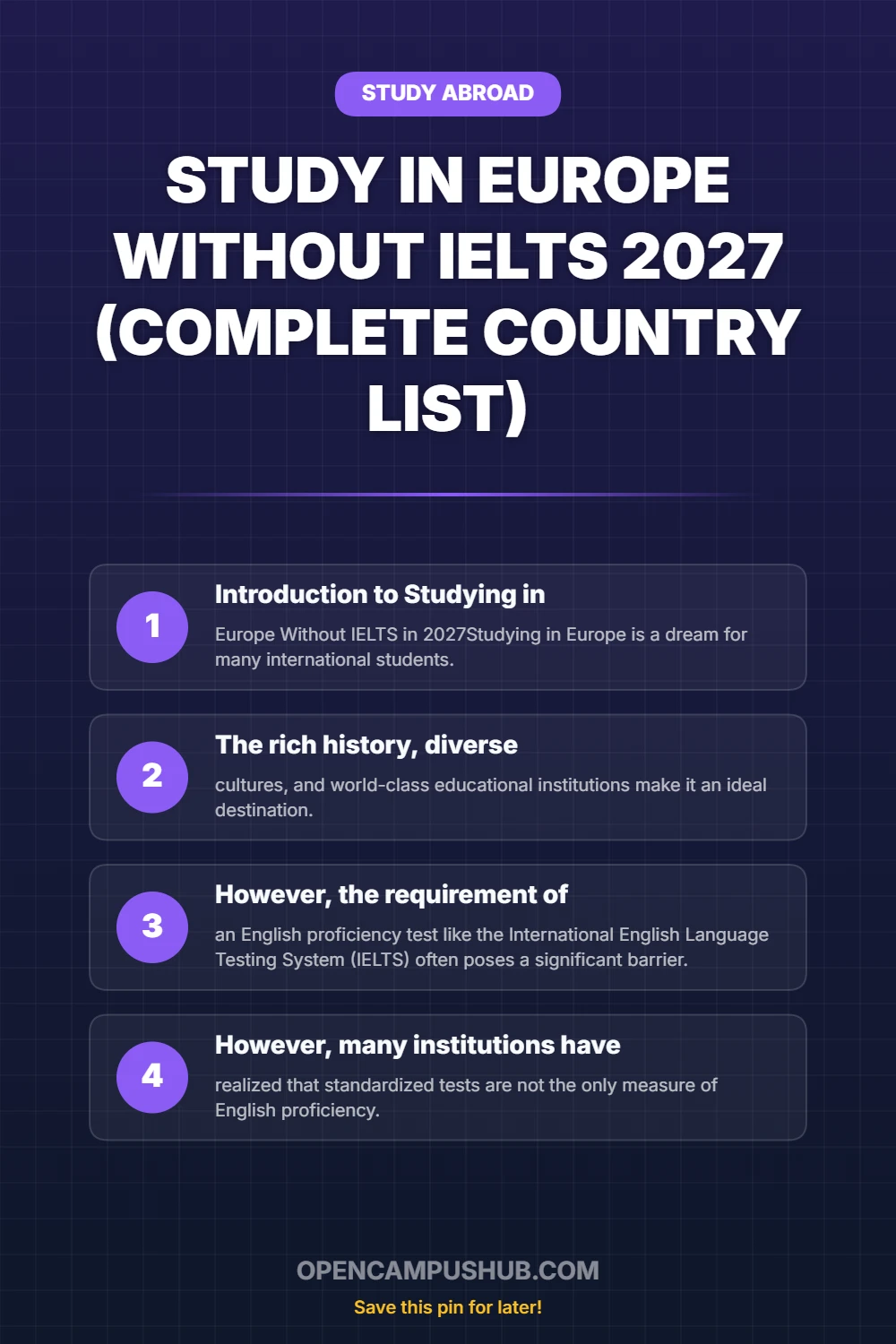
Introduction to Studying in Europe Without IELTS in 2027Studying in Europe is a dream for many international students.
- 2
The rich history, diverse cultures, and world-class educational institutions make it an ideal destination.
- 3
However, the requirement of an English proficiency test like the International English Language Testing System (IELTS) often poses a significant barrier.
- 4
However, many institutions have realized that standardized tests are not the only measure of English proficiency.
Introduction to Studying in Europe Without IELTS in 2027
Studying in Europe is a dream for many international students. The rich history, diverse cultures, and world-class educational institutions make it an ideal destination. However, the requirement of an English proficiency test like the International English Language Testing System (IELTS) often poses a significant barrier. The good news is that in 2027, many European countries and universities offer alternatives to IELTS, allowing students to pursue their academic goals without this hurdle.
Table of Contents
Why Universities Ask for IELTS and Why Exemptions Exist
Generally, universities ask for IELTS to ensure that students can comprehend coursework taught in English. However, many institutions have realized that standardized tests are not the only measure of English proficiency. Students who have completed their previous education in English, or those from English-speaking countries, are often exempt. Additionally, the Medium of Instruction (MOI) certificate is increasingly accepted as valid proof of language skills.
Top European Countries That Don’t Require IELTS
1. Italy: The Hub of Arts and Sciences
Italy is renowned for its welcoming stance towards international students and offers numerous programs taught in English. Many Italian universities do not require IELTS if you can prove that your previous degree was taught entirely in English (using an MOI certificate).
- Top Universities: University of Milan, University of Bologna, Sapienza University of Rome, University of Padua.
- Exemption Criteria: MOI Certificate from previous university, or passing an online interview with the admissions committee.
- Visa Process: The Italian consulate generally accepts the university’s language waiver, though it is always recommended to check the specific requirements of the consulate in your country.
2. Hungary: Affordable and High-Quality Education
Hungary has emerged as a popular destination for international students, largely due to the Stipendium Hungaricum scholarship and affordable tuition fees. Many Hungarian universities are flexible with their English language requirements.
- Top Universities: University of Debrecen, Eötvös Loránd University, University of Pécs.
- Exemption Criteria: Medium of Instruction (MOI) certificate, or an internal university English test, or sometimes just an interview.
- Visa Process: Hungarian visa requirements are relatively straightforward, and an admission letter with a language waiver is usually sufficient for the student visa.
3. Poland: Rapidly Growing Educational Hub
Poland offers a dynamic and rapidly growing educational environment with relatively low living costs. It is an excellent option for students seeking quality education without the IELTS requirement.
- Top Universities: Warsaw University of Technology, Jagiellonian University, University of Warsaw.
- Exemption Criteria: Students who have completed their previous degree in English, or those who pass a Skype interview conducted by the university.
- Visa Process: Polish consulates often accept a university-issued letter stating that the student has met the English language requirements through alternative means.
4. Spain: Sun, Culture, and Academic Excellence
Spain is not just a popular tourist destination; it is also a fantastic place to study. While many programs are in Spanish, the number of English-taught programs is growing rapidly.
- Top Universities: University of Barcelona, Complutense University of Madrid, University of Valencia.
- Exemption Criteria: If you are applying for a program taught in Spanish, you may need a DELE certificate. For English programs, a certificate from a recognized English school or an MOI might suffice. Some universities also have their own English proficiency tests.
5. Germany: Specific Programs and Private Universities
Germany is famous for its tuition-free public universities. While many public universities strictly require IELTS or TOEFL, there are exceptions, particularly among private institutions and specific programs.
- Top Universities: EU Business School, IU International University of Applied Sciences, Free University of Berlin (specific programs).
- Exemption Criteria: Private universities are generally more lenient and often accept an MOI certificate or conduct their own English assessment. Some public universities may also accept an MOI if you have a bachelor degree taught in English.
The Medium of Instruction (MOI) Certificate
The MOI certificate is perhaps the most crucial document if you plan to study in Europe without IELTS. It is a letter from your previous educational institution stating that English was the language of instruction for your degree.
How to Use the MOI Certificate
- Obtain the certificate from your university registrar.
- Ensure it is on the official university letterhead, signed, and stamped.
- Submit it along with your application documents to your chosen European university.
Alternatives to IELTS
If you don’t have an MOI certificate and cannot take the IELTS, there are other alternatives you might consider:
- Duolingo English Test (DET): Increasingly popular, affordable, and can be taken from home.
- Pearson Test of English (PTE): A computer-based test that provides quick results.
- Cambridge English Exams: widely accepted in Europe and generally valid for life.
- TOEFL iBT Home Edition: Accepted by many institutions worldwide.
- University Internal Exams: Some universities offer their own English tests.
Table: Comparison of IELTS Alternatives
| Test/Certificate | Acceptance in Europe | Cost | Validity |
|---|---|---|---|
| MOI Certificate | High (in specific countries) | Usually Free | Depends on university |
| Duolingo (DET) | Growing rapidly | Low | 2 years |
| PTE Academic | Very High | Medium to High | 2 years |
| Cambridge Exams | Very High | Medium | Lifetime |
Schengen Visa Without IELTS
A common concern is whether you can get a Schengen student visa without an IELTS certificate. The general rule is that the visa consulate follows the university’s admission criteria. If the university has admitted you without IELTS (e.g., based on an MOI certificate), the consulate will typically respect that decision. However, the visa officer must be convinced of your communication skills during the visa interview. Therefore, while you may not need IELTS on paper, you must still be able to communicate effectively in English.
Don't miss the next deadline!
Join our WhatsApp Channel for instant alerts.
Frequently Asked Questions (FAQ)
1. Is it really possible to study in Europe without IELTS?
Yes, absolutely. Many countries and universities, particularly in Italy, Hungary, and Poland, accept alternative proofs of English proficiency, such as the MOI certificate.
2. Will not having IELTS affect my scholarship chances?
It depends on the scholarship. Some prestigious scholarships may require IELTS, but many university-specific and government scholarships (like Stipendium Hungaricum) accept alternative language certificates.
3. What if my visa gets rejected due to a lack of IELTS?
Visa rejections purely due to a lack of IELTS are rare if the university has explicitly waived the requirement in your admission letter. Ensure you carry the MOI certificate and admission letter to your visa interview and communicate confidently.
4. Are English-taught programs in Europe expensive?
Not necessarily. Countries like Germany and Norway offer tuition-free or very low-tuition education, while places like Hungary and Poland are generally very affordable compared to the US or UK.
5. Can I work part-time in Europe without knowing the local language?
It is possible, especially in multinational companies or tourist areas, but knowing the local language significantly increases your job prospects and helps you integrate better into society.
Conclusion
In 2027, the dream of studying in Europe is more accessible than ever, even without an IELTS score. By strategically choosing your destination—focusing on countries like Italy, Hungary, and Poland—and leveraging alternatives like the Medium of Instruction (MOI) certificate, you can secure admission to excellent universities. Always thoroughly research the specific requirements of both your target universities and the respective national consulates to ensure a smooth application and visa process. Start preparing your documents early, and embark on your European educational journey with confidence.
Written by the OpenCampusHub Editorial Team
Our global team of education and mobility experts is dedicated to verifying international opportunities. We ensure every guide meets strict standards for accuracy, leveraging official sources and real-world data.
Share this article
Discussion
Welcome to the discussion. Please keep questions relevant to the 2026 cycle. Our team aims to respond to critical inquiries within 48 hours.