Join our Official WhatsApp Channel
Get daily alerts on fully funded scholarships, remote jobs, and visa sponsorships before anyone else.
Free community. No paid links or spam.
Quick Intelligence
- 1
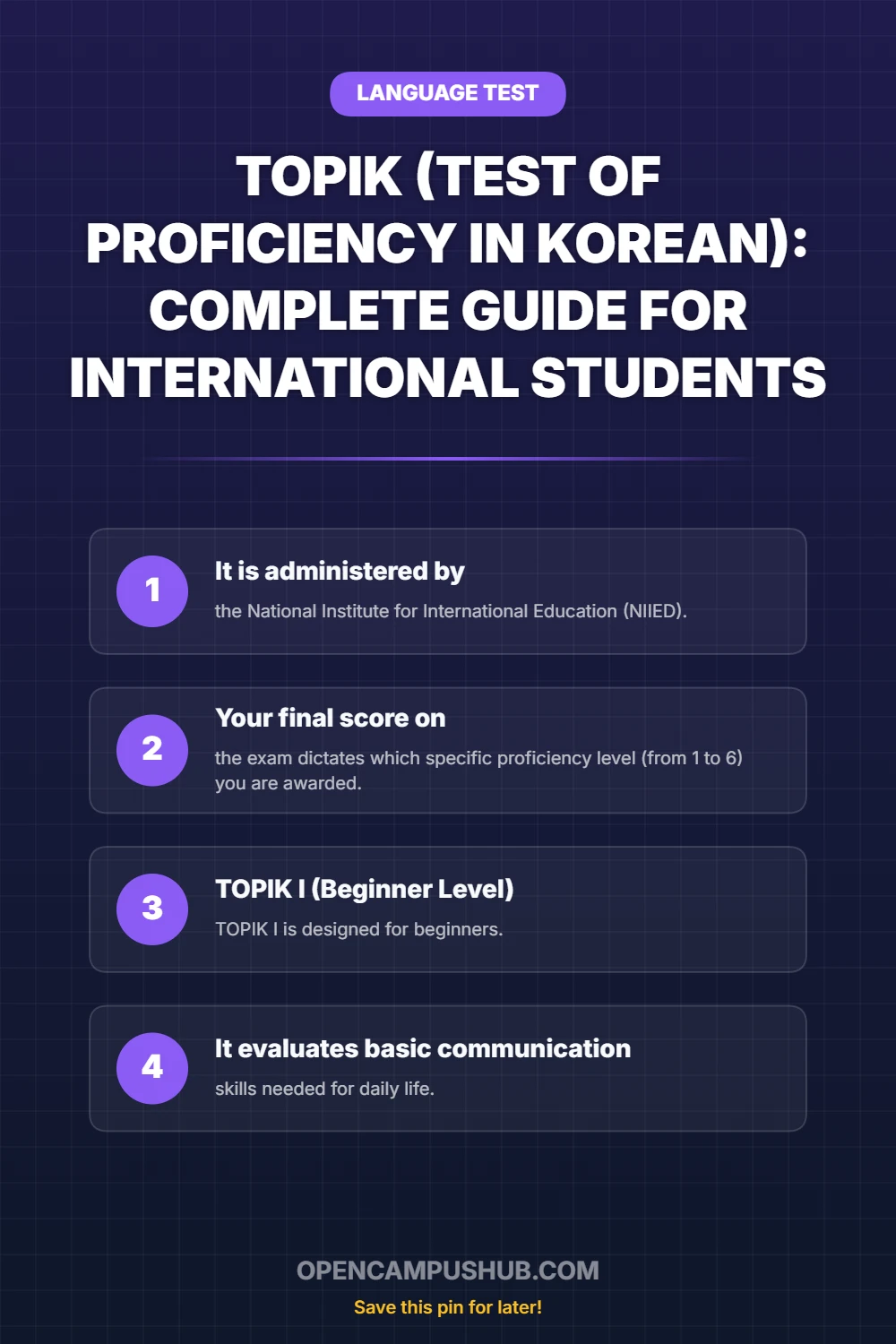
It is administered by the National Institute for International Education (NIIED).
- 2
Your final score on the exam dictates which specific proficiency level (from 1 to 6) you are awarded.
- 3
TOPIK I (Beginner Level) TOPIK I is designed for beginners.
- 4
It evaluates basic communication skills needed for daily life.
Introduction to the TOPIK Exam
The Test of Proficiency in Korean (TOPIK) is a written test designed to measure the ability of non-native speakers for expression and comprehension in the Korean language. It is administered by the National Institute for International Education (NIIED). For international students aspiring to study at top universities in South Korea or professionals looking to work for Korean companies, TOPIK is the gold standard of language certification. In this complete guide, we will explore the differences between TOPIK I and TOPIK II, scoring mechanics, preparation strategies, and how crucial TOPIK is for the Global Korea Scholarship (GKS/KGSP).
Table of Contents
Understanding the TOPIK Structure: TOPIK I vs TOPIK II
Unlike some other language exams that require you to register for a specific proficiency level (like the JLPT), TOPIK is divided into just two test levels: TOPIK I and TOPIK II. Your final score on the exam dictates which specific proficiency level (from 1 to 6) you are awarded.
TOPIK I (Beginner Level)
TOPIK I is designed for beginners. It evaluates basic communication skills needed for daily life.
- Test Sections: Listening (40 minutes, 30 questions) and Reading (60 minutes, 40 questions).
- Total Score: 200 points.
- Levels Awarded:
- Level 1 (Over 80 points): Ability to carry out basic conversations related to daily survival, such as greeting, purchasing, ordering, etc.
- Level 2 (Over 140 points): Ability to handle phone calls, ask for favors, and understand simple public signs. Often sufficient for F-6 marriage visa requirements.
TOPIK II (Intermediate & Advanced Level)
TOPIK II is for intermediate and advanced learners and is significantly more rigorous. It includes a writing section, which many students find the most challenging.
- Test Sections: Listening (60 mins, 50 questions), Writing (50 mins, 4 short-answer/essay questions), and Reading (70 mins, 50 questions).
- Total Score: 300 points.
- Levels Awarded:
- Level 3 (Over 120 points): Basic competency for everyday life without difficulty. (Minimum requirement for many undergraduate admissions).
- Level 4 (Over 150 points): Capable of understanding news broadcasts and reading general newspapers. (Often required for graduation or scholarship continuation).
- Level 5 (Over 190 points): Fluency in utilizing the language for professional research or work.
- Level 6 (Over 230 points): Absolute fluency, near-native proficiency. Essential for advanced academic research and highly competitive job markets.
The Importance of TOPIK for GKS/KGSP Scholarships
The Global Korea Scholarship (GKS), formerly known as the Korean Government Scholarship Program (KGSP), is highly competitive. Having a strong TOPIK score can significantly boost your application.
- Application Boost: While you can apply for GKS without prior Korean knowledge (you will be given a 1-year language program), holding a TOPIK Level 3 or higher gives you extra points during the selection process.
- Direct Degree Entry: If you already possess a valid TOPIK Level 5 or 6, you are exempted from the mandatory 1-year Korean language training and can start your degree program immediately, alongside receiving an additional monthly stipend.
- Graduation Requirements: Even if you enter university through an English-taught track, many Korean universities require a minimum TOPIK Level 4 to graduate.
TOPIK Test Dates and Registration for 2027
TOPIK is held multiple times a year in South Korea (usually 6 times) and globally (usually 3 to 4 times). For international applicants outside Korea, the exam is typically held in April, July, and October.
Estimated 2027 Global Exam Months:
- April 2027: Registration in January/February.
- July 2027: Registration in May.
- October 2027: Registration in August.
Check the official TOPIK website (topik.go.kr) or your local Korean embassy/cultural center for exact dates and registration procedures, as seats fill up rapidly.
Preparation Strategies for TOPIK
Preparing for TOPIK requires a balanced approach to vocabulary, grammar, and test-taking strategies.
- Master TOPIK Vocabulary: Korean vocabulary heavily relies on Hanja (Chinese characters) at advanced levels. Learning Hanja roots will exponentially expand your vocabulary for TOPIK II.
- Conquer the Writing Section (TOPIK II): The writing section includes a graph analysis and an argumentative essay. Memorize fixed sentence structures and transition words (therefore, however, in contrast) specific to academic Korean writing.
- Past Papers are King: The NIIED releases past papers periodically. Practicing under timed conditions with real past papers is the most effective way to improve your score, particularly for the fast-paced reading section.
- Listen Actively: Watch Korean news and documentaries rather than just K-Dramas, as TOPIK listening tests often feature interviews, lectures, and news reports.
Don't miss the next deadline!
Join our WhatsApp Channel for instant alerts.
Frequently Asked Questions (FAQ)
How long is a TOPIK certificate valid?
A TOPIK certificate is valid for two years from the date of the test result announcement.
Can I fail TOPIK II and get nothing?
Yes. If you take TOPIK II and score below 120 points (the threshold for Level 3), you will fail and receive no certification level at all.
Is TOPIK computer-based?
Currently, TOPIK is primarily a paper-and-pencil test. However, South Korea has been testing and slowly rolling out Internet-Based Testing (IBT TOPIK), which may become standard by 2027.
Do I need TOPIK if my degree is taught entirely in English?
While admission might not require it, everyday life in Korea and administrative processes at the university will be incredibly difficult without basic Korean. Furthermore, government regulations often require international students to achieve at least Level 4 to graduate, regardless of the instruction language.
Written by the OpenCampusHub Editorial Team
Our global team of education and mobility experts is dedicated to verifying international opportunities. We ensure every guide meets strict standards for accuracy, leveraging official sources and real-world data.
Share this article
Discussion
Welcome to the discussion. Please keep questions relevant to the 2026 cycle. Our team aims to respond to critical inquiries within 48 hours.