Join our Official WhatsApp Channel
Get daily alerts on fully funded scholarships, remote jobs, and visa sponsorships before anyone else.
Free community. No paid links or spam.
Quick Intelligence
- 1
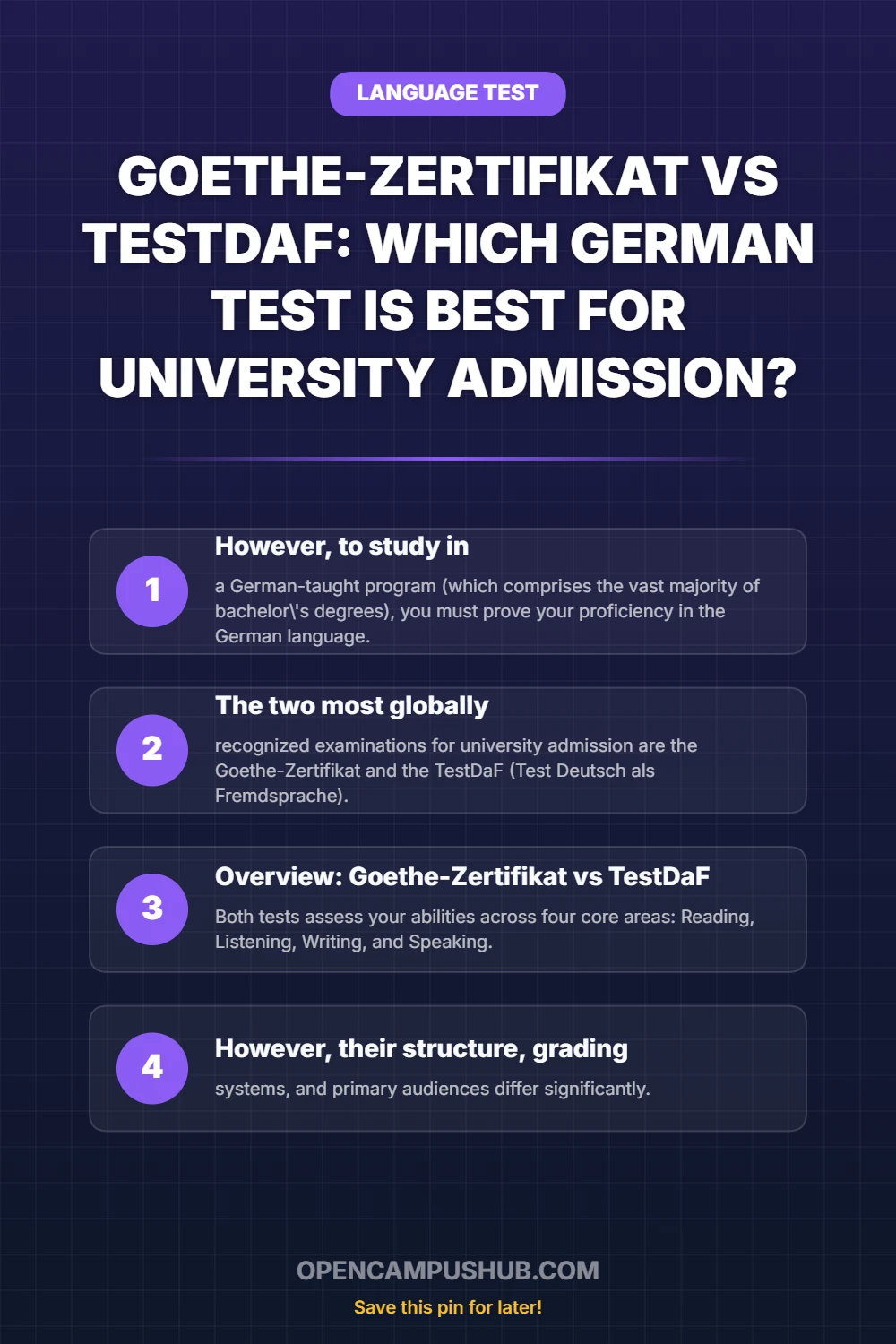
The two most globally recognized examinations for university admission are the Goethe-Zertifikat and the TestDaF (Test Deutsch als Fremdsprache).
- 2
Overview: Goethe-Zertifikat vs TestDaF Both tests assess your abilities across four core areas: Reading, Listening, Writing, and Speaking.
- 3
However, their structure, grading systems, and primary audiences differ significantly.
- 4
For university admission, you generally need the Goethe-Zertifikat C1 or C2: Großes Deutsches Sprachdiplom (GDS).
Introduction to German Language Requirements
Germany is one of the most popular study destinations in the world, offering world-class education often with zero or very low tuition fees. However, to study in a German-taught program (which comprises the vast majority of bachelor\'s degrees), you must prove your proficiency in the German language. The two most globally recognized examinations for university admission are the Goethe-Zertifikat and the TestDaF (Test Deutsch als Fremdsprache). But which one should you take? In this comprehensive guide, we will compare the Goethe-Zertifikat and TestDaF across format, scoring, cost, and universal acceptance by German universities to help you make an informed decision.
Table of Contents
Overview: Goethe-Zertifikat vs TestDaF
Both tests assess your abilities across four core areas: Reading, Listening, Writing, and Speaking. However, their structure, grading systems, and primary audiences differ significantly.
Goethe-Zertifikat (C1/C2)
The Goethe-Institut offers German language exams corresponding to the six levels of the Common European Framework of Reference for Languages (CEFR), from A1 to C2. For university admission, you generally need the Goethe-Zertifikat C1 or C2: Großes Deutsches Sprachdiplom (GDS).
- Focus: General and academic German. The vocabulary and topics are broad, encompassing literature, society, daily life, and general science.
- Format: Modular format available for some levels (you can retake individual sections if you fail one).
- Target Audience: Anyone needing proof of German proficiency for immigration, work, or study.
TestDaF
The TestDaF is specifically designed for academic purposes. It caters primarily to international students planning to study in Germany or researchers heading to German institutes.
- Focus: Strictly academic context. Topics revolve around university life, scientific texts, lectures, and academic discussions.
- Format: A single, unified test. You take all four sections in one sitting.
- Target Audience: Future university students and academics.
Detailed Comparison: Format, Scoring, and Difficulty
1. Test Format and Content
The TestDaF is highly predictable. The reading section always features a university matching task, a journalistic text, and a scientific journal article. The writing section always requires summarizing a graph and stating your opinion. Because the scope is limited to university life, many students find preparing for TestDaF more straightforward, as they can memorize academic vocabulary and graph-description phrases.
The Goethe-Zertifikat C1 features a wider array of topics. You might read about environmental policies, psychology, or historical events. The writing section often requires writing a formal letter or an essay on a general societal issue. The speaking section involves a presentation and a discussion, often requiring a wider vocabulary than the highly structured TestDaF speaking tasks.
2. Scoring Systems
| Feature | TestDaF | Goethe-Zertifikat C1 |
|---|---|---|
| Scoring System | Graded into levels: TDN 3, TDN 4, TDN 5 per section. | Points based (out of 100). Minimum 60 points to pass overall. |
| University Requirement | Usually TDN 4 in all four sections. | A passing grade on the C1 exam. |
| Partial Failure | If you score TDN 3 in one section, you often miss university requirements and must retake the ENTIRE test. | The new modular format allows retaking only the failed section (Reading, Writing, etc.). |
3. The "Difficulty" Factor: Which is Easier?
There is no definitive "easier" test, as it depends on your strengths:
- TestDaF is "easier" if: You excel at structured preparation, memorizing academic templates, analyzing graphs, and you prefer taking speaking tests with a computer rather than a human examiner.
- Goethe C1 is "easier" if: You have a broad vocabulary, prefer reading general interest/literary articles over dry scientific texts, and perform better in face-to-face speaking exams where you can interact dynamically with an examiner.
University Acceptance and Recognition
Both certificates are universally recognized by German universities. However, there are nuances:
- TestDaF (TDN 4 in all sections): This is the golden ticket. Every university in Germany recognizes TDN 4x4 as sufficient linguistic proof for enrollment in German-taught programs.
- Goethe-Zertifikat C1: Widely accepted, but some highly competitive universities or specific programs (like Medicine or Law) might require Goethe C2, whereas they still accept TestDaF TDN 4 or TDN 5. Always check the specific requirements of your target university and program.
Cost and Test Dates
TestDaF: Held roughly six times a year globally. The cost varies by country, generally ranging between 100 EUR and 210 EUR.
Goethe-Zertifikat: Held much more frequently (often monthly or bi-monthly at major Goethe-Instituts). Costs also vary, typically ranging from 200 EUR to 300 EUR, making it generally slightly more expensive than the TestDaF.
Don't miss the next deadline!
Join our WhatsApp Channel for instant alerts.
Frequently Asked Questions (FAQ)
Do these certificates expire?
Officially, neither the TestDaF nor the Goethe-Zertifikat expires. However, some universities have internal policies requiring language certificates to be no older than 2 or 3 years.
What about the DSH exam?
The DSH (Deutsche Sprachprüfung für den Hochschulzugang) is another accepted exam, but it is typically only offered locally AT German universities, not worldwide. You usually take it right before your semester starts in Germany.
Can I apply for a student visa with a B2 certificate?
Yes, for the purpose of a study-preparation visa (to take language classes in Germany), a B1 or B2 is often sufficient. However, for direct enrollment into a degree program, C1 or TestDaF TDN 4 is required.
Written by the OpenCampusHub Editorial Team
Our global team of education and mobility experts is dedicated to verifying international opportunities. We ensure every guide meets strict standards for accuracy, leveraging official sources and real-world data.
Share this article
Discussion
Welcome to the discussion. Please keep questions relevant to the 2026 cycle. Our team aims to respond to critical inquiries within 48 hours.