Get Scholarship Alerts on WhatsApp
Don't miss the next deadline! Join our channel for fully funded scholarships & study abroad tips.
Free community. No paid links or spam.
Quick Intelligence
- 1
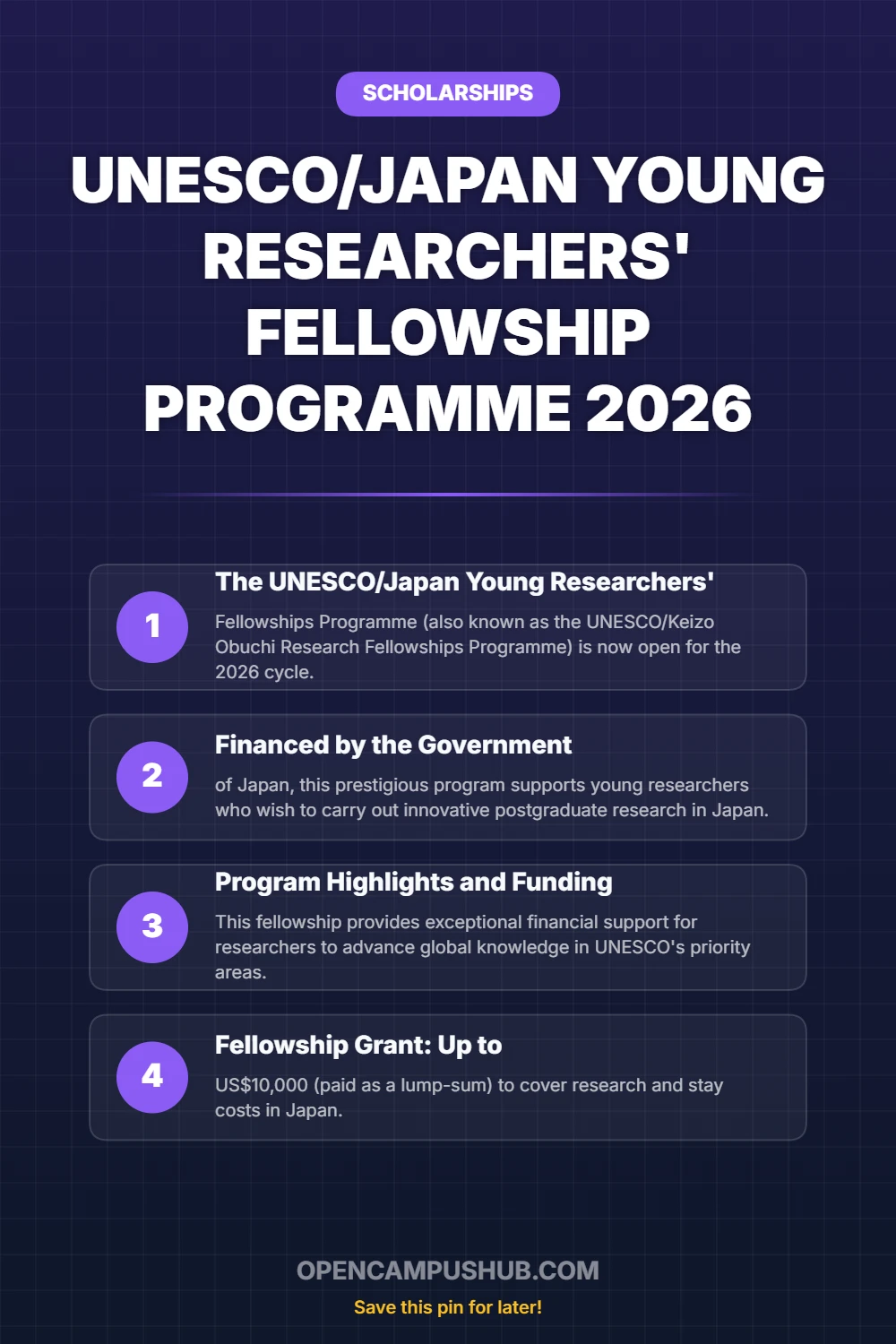
Financed by the Government of Japan, this prestigious program supports young researchers who wish to carry out innovative postgraduate research in Japan.
- 2
Fellowship Grant: Up to US$10,000 (paid as a lump-sum) to cover research and stay costs in Japan.
- 3
Availability: 10 exclusive fellowships are awarded per cycle.
- 4
Research Timeline: All funded research stays in Japan must be completed by December 2027.
The UNESCO/Japan Young Researchers' Fellowships Programme (also known as the UNESCO/Keizo Obuchi Research Fellowships Programme) is now open for the 2026 cycle. Financed by the Government of Japan, this prestigious program supports young researchers who wish to carry out innovative postgraduate research in Japan.
Table of Contents
Program Highlights and Funding
This fellowship provides exceptional financial support for researchers to advance global knowledge in UNESCO's priority areas.
- Fellowship Grant: Up to US$10,000 (paid as a lump-sum) to cover research and stay costs in Japan.
- Duration: 3 to 9 months of research.
- Availability: 10 exclusive fellowships are awarded per cycle.
- Research Timeline: All funded research stays in Japan must be completed by December 2027.
- Application Fee: None (Applying is completely free).
Eligible Fields of Study
Your research proposal must align closely with one of the following domains:
- Heritage Conservation & Management
- Sustainable Development
- Artificial Intelligence (AI)
- Interdisciplinary Research related to UNESCO's primary priorities.
Eligibility Criteria
To be considered for the Keizo Obuchi Fellowship, applicants must meet all the following conditions:
- Be a national of a developing country that is an invited UNESCO Member State (check the official list for the 2026 cycle).
- Be 40 years old or younger at the time of application.
- Hold at least a Master's degree or equivalent.
- Have strong academic background and high research potential.
- Possess excellent reading and writing skills in the language of instruction/supervision at the Japanese host institution.
- Crucial Requirement: You must have already received a formal acceptance letter from an academic supervisor at a Japanese university or research institution.
Application Process & Required Documents
Applications are not submitted directly to UNESCO. They must be nominated and forwarded through your country's National Commission for UNESCO.
Documents Needed:
- Completed Official Application Form
- Detailed Research Proposal
- Curriculum Vitae (CV)
- Master's Degree Certificates and Transcripts
- Acceptance Letter from Japanese Academic Supervisor
- Language Proficiency Certificate (if required by the host)
- Copy of Passport/ID
Application Deadline: September 30, 2026 (Midnight, Paris time).
Official Information Link: www.unesco.org/en/fellowships/keizo-obuchi
Don't miss the next scholarship!
Join our WhatsApp Channel for instant scholarship alerts.
Frequently Asked Questions (FAQs)
How do I find a Japanese host institution or supervisor?
You must independently search for Japanese universities that specialize in your research field (e.g., AI or Sustainable Development), contact professors whose work aligns with yours, and request them to supervise your 3-9 month research stay.
Is the $10,000 paid monthly?
No, the UNESCO/Japan fellowship is typically paid as a lump-sum grant intended to cover your airfare, accommodation, and research-related living expenses for the entirety of your stay in Japan.
Written by the OpenCampusHub Editorial Team
Our global team of education and mobility experts is dedicated to verifying international opportunities. We ensure every guide meets strict standards for accuracy, leveraging official sources and real-world data.
Share this article
Discussion
Welcome to the discussion. Please keep questions relevant to the 2026 cycle. Our team aims to respond to critical inquiries within 48 hours.